Bishop Samuel Seabury’s Vase
Born in 1729 in North Groton (now Ledyard), Connecticut, Samuel Seabury was an important figure in American religious history. He urged the creation of Washington College (now Trinity College) in Hartford. Educated at Yale and at the University of Edinburgh, Scotland, he founded the Episcopal Academy of Connecticut (now Cheshire Academy) in 1794, and died in New London two years later.
Seabury served parishes in New Brunswick, New Jersey; Jamaica, New York; and Westchester (now the Bronx), New York from 1754 to 1775. He was a Loyalist during the American Revolution, writing several articles opposing independence. He was imprisoned in Connecticut for a time, and was Chaplain of the King’s American Regiment in New York City until the end of the war. Elected America’s first Bishop in 1783, he couldn’t be consecrated in the United States because there were no Anglican Bishops in America to consecrate him. (He eventually was consecrated in Scotland.) Returning to Connecticut, he lived in New London.
In 1794, he founded the Episcopal Academy of Connecticut; despite its name, and contrary to the usual practice of the time, its constitution stated that students might attend any religious services practiced by their families. Admitting its first students in 1796, it was sometimes referred to as “Seabury Academy.”
Although at one time Seabury had written that “slavery is a very bad thing,” equating it to “cruel oppression,” he owned slaves; at his death, two were mentioned in his will. Modern thinking is that when Seabury mentioned “slavery,” he was referring to White people being held in bondage.
One of his books was titled “American Slavery … Justified by the Law of Nature.”
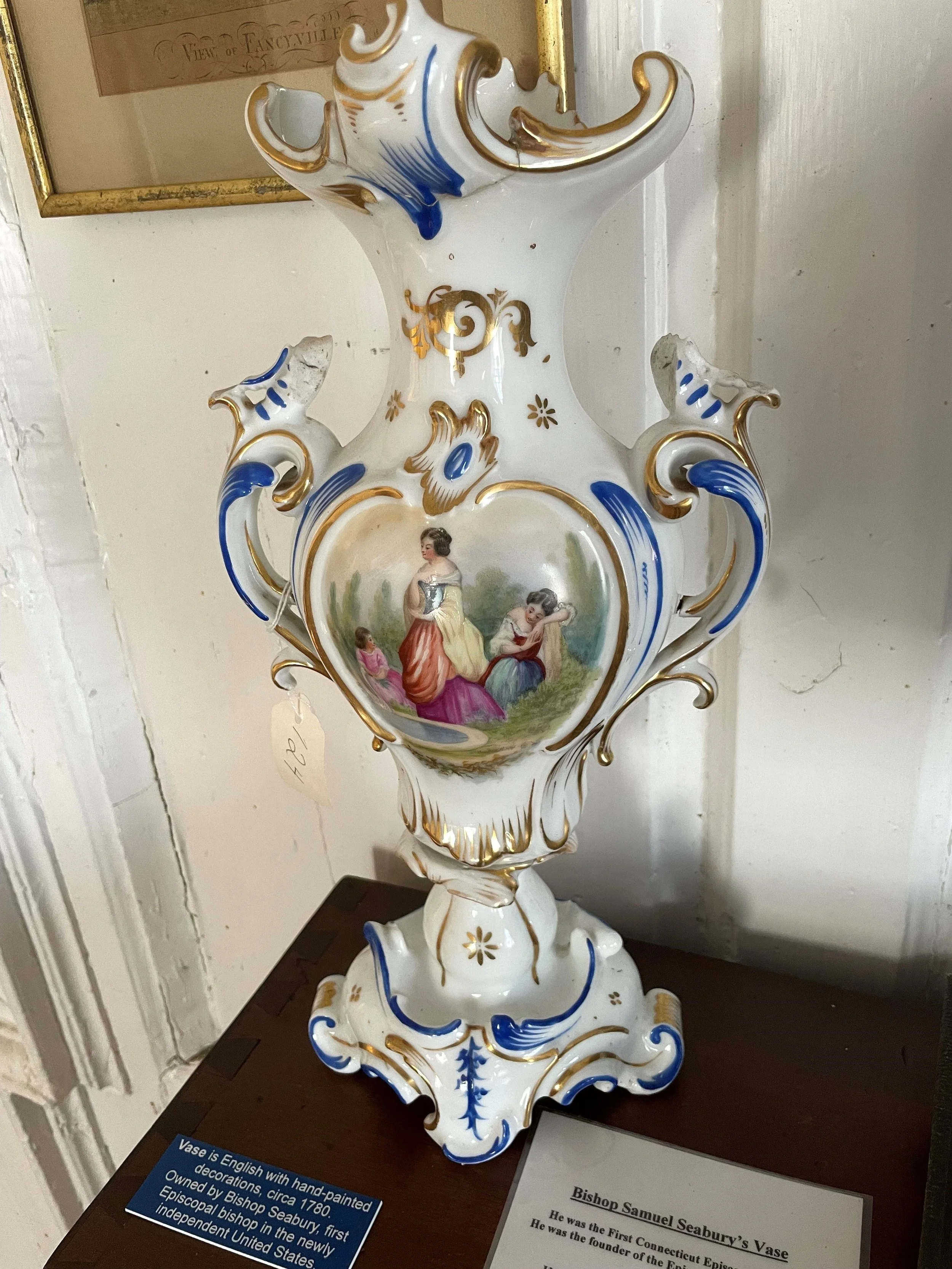
This circa 1780 English vase with hand-painted decorations was owned by Samuel Seabury, the First American Episcopal Bishop and the founder of what is now Cheshire Academy.